Wednesday, May 26, 2021

Addo Elephant Portrait

 I have an intention to do some art every day. It never really works out that way... L but I try. One approach is to have a sheet prepared and waiting with an outline of a subject on it. Then I can spend an hour, or a few minutes, with pencil and putty rubber developing the image. I did this with some of the locomotive drawings I mention in previous posts. I thought that living in Africa made wildlife a logical subject. I have hundreds of photographs to draw on (Excuse the pun).

This work is intended to be a bit of a departure from the – what I see as traditional – view of an Elephant with big tusks, facing the viewer, with dust and so on around its legs. I decided to focus on the face alone, and so I have merely suggested the forelegs and left everything else out. See what you think.

Portrait of an Elephant in Addo NP

The drawing is on A3 paper. I used a set of Staedtler Mars Lumograph pencils and 200 gsm drawing paper. To date these are the best pencils I have worked with for drawings of this kind.

Friday, May 21, 2021

SAAB Gripen over the Swartberg - creation of an oil painting

 This painting was quite an involved project. I began with a concept of two SAAF Gripen flying over the Swartberg Pass in the South African Swartberg Mountains. My inspiration came from experiencing a pair of these aircraft low flying over the area whilst I was out walking at a place called Groenfontein.

I had taken a photograph from the top of the pass so had a backdrop from a fair height looking south. For the aircraft image, I used my Airfix 1:72 scale model of a SAAB Gripen. I placed it in different poses on a flat surface, and photographed it with a digital camera.

Composition

These photographs (Image 1) were then rather crudely combined using Microsoft PowerPoint. The resulting image / slide was saved as a jpg format file and posted in the Aviation Art forum on Wet Canvas. This has proved to be a fairly reliable and constructive source of advice on matters relating to aviation and art. I have used it for several years and like it.

Image 1 - Airfix model mock up

One member of the forum advised me to use a free software package called ’Sketchup’; it has a library of three dimensional models of most aircraft which can be positioned and posed easily in a virtual space. I did this and then placed the resulting images into my PowerPoint background and posed a selection of compositions on the Wet Canvas forum for additional ideas and criticism (Image 2).


Image 2 - Thumbnails of Sketchup composition

From these ideas and with some ‘votes’ from the forum members I selected version two as the basis for the eventual painting.

Artwork development

I usually start my artwork with pencil drawings. I find this provides me with a feel for how much tonal range I need to use to give the feeling of depth to an image. I am basically creating atmospheric perspective. The drawing process also assists me in becoming familiar with the shape and salient features of the subject (Image 3).


Image 3 - Initial A4 drawings

Once I was happy with the pencil drawings, the ones above were an A4 initial sketch. I worked from them on A3 paper to re draw them in more detail.

Watercolour work

Following the drawing stage I moved to the colour decision process. I restored an airbrush and compressor arrangement that has languished in my cupboard for many years and used it to create a background wash. Onto this wash I then painted the two aircraft (Image 4).


Image 4 - Watercolour study

I can’t say I was particularly happy with the result as a piece of art in its own right. But felt it served its purpose. How wrong I was!

My main reason for producing a watercolour in one of these projects is to create a full colour idea of what the final painting will look like. It tells me what colours to use and where they may clash. Except in this case I did not pay enough attention to the small issue of aircraft camouflage!

The oil painting

The process I am describing started in August 2020, by the time I started on the Oil painting proper it was October.

I outlined my composition and created a Burnt Umber under painting of the aircraft, then worked over this with Payne’s Grey. After that I glazed in some hues that I thought would serve as the basis for the landscape behind the aircraft.

I then painted over the aircraft in a colour mix that more closely met the colours visible on photographs of the real aircraft in service with the SAAF. This is where I began to see a problem. The SAAF colour scheme is designed to make the aircraft fade into the haze of distant clouds or landscapes (Image 5).


Image 5 - Initial oil painting

I decided at this point that the landscape had to be darker than the aircraft so that they would stand out. So I duly spent some ‘happy time’ rendering a suitably realistic landscape behind the aircraft (Image 6).


Image 6 - Adjusted painting with landscape completed

This looked quite hopeful until I converted the image to greyscale. I could see tone was an issue and any ideas of glazing in a distant haze would also allow the aircraft to blend in! (Image 7)


Image 7 - Greyscale of adjusted painting

As a result I worked this version over with some Umber to darken the background and ‘cool it down’ so it would recede (Image 8).


Image 8 - Landscape with Umber glaze

This worked though I lost some of my lovely landscape details. With the addition of some contrails I did manage to gain a feel for movement and speed in the image. Many aviation paintings depict the aircraft in perfect focus and detail which makes the machine hang motionless in the air.


Image 9 Greyscale image of Umber glaze

A monochrome version of the image revealed that the tonal range, plus the contrast with the landscape, now brought the aircraft into the foreground (Image 9).

My final step was to complete the detailing of the aircraft and enhance the contrails to strengthen the feel for speed (Image 10).

Image 10 - Final painting / artwork

Winsor & Newton Artisan (water mixable oils) colours on Fredix canvas board. (50 x 76 cm).

Sunday, January 31, 2021

Outeniqua steam engine

 This is my second steam engine, I originally planned to render it on A3 format paper, but during the preparation process I decided that what I had prepared would work better in A4.

This image represents a departure in my process from working with a hard copy (Photograph or print), to working off a computer screen.

I scanned the original photograph (a 35mm colour slide) and then loaded the digital image into MS PowerPoint. I created a grid of squares in the PowerPoint package and overlaid these on the steam train image. Finally I saved that slide as a jpg picture which I could display on an old laptop screen and refer to as I started drawing.

Original photograph with grid lines superimposed

I initially drew the scaled up grid out on 60gsm A3 paper and then drew the salient features of the steam engine using the grid for guidance. Once I had a simple line drawing my intent was to use a light box to transfer the lines, without the grid, onto the final art support. When I looked at my line drawing I realized that the scale I had drawn the engine to fitted better in an A4 format and the rest of the image was not adding anything to the drawing.

With the above considerations in mind, I traced the outline of the train onto 200gsm paper and then worked it up using Staedtler Mars Lumograph pencils. I found the paper a little too rough in texture for my liking. I was not able to get lines as fine as I wished, and dark areas persist in having bright aspects. 

A4 drawing of steam engine in Garden Route lakes area

There are a few perspective errors in the drawing, so more care next time! As I worked on the drawing I discovered that the boiler and the various lines along and around it are more complex that they first appear, in fact what look like lines or joins at first glance turn out to be part of a sophisticated set of pipe work!

The original photograph was taken in the mid 1990s in the wetland area between Knysna and George on the S. Coast of South Africa. This train is moving timber from the forests around Knysna. A landslide blocked the line and this traffic is now fulfilled by road transport. The loss is a pity as this was a tourist attraction.


Wednesday, January 27, 2021

A departure from realism with Paul Birchall

The past two weeks were occupied with a UCT summer school course delivered via Microsoft Teams. Our instructor was a well known local artist, Paul Birchall. He led the group of attendees through a creative process that resulted in my production of something completely different to my normal works.

Postcards from abroad

One early exercise Paul led us through was to select three images and use them as the face of an imaginary postcard. Then use the image to illustrate the message home written on the reverse of the postcard.

I selected three images of paintings by Caravaggio, and used them to construct a set of weekly cards home from a holidaymaker visiting Italy in these ‘Covidian’ times.

Postcard 1


Dear Mum,

I have arrived in Italy and managed to find some shared accommodation in the ‘old quarter’ of the city. Because of the pandemic rules, I have to spend fourteen days inside; fortunately I will not be alone. A young lady from Alexandria is also staying at the hostel.

My quarantine companion tells me she is here for a part in a film. This evening I came across her in the lounge clutching a long sharp sword. I did not know that Italians allowed such things in public. When I asked about it she said it was a prop for a film. She is hoping for a part in the film as the tragic heroine.

Postcard 2


Dear Mum,

I have now been a week in this hostel. I am not sure the young actress also staying in the hostel is what she claims to be. There has been a bit of drama here. Another guest was found this morning in his room with his head cut off! All I can think of is the sword I saw her with when I first arrived.

The police say they arrested the cleaning lady early this morning. She claims she found the victims head in a bag. Her story is that she found the bag in the hall and did not know what was in it! I must say she is a frail old thing. I am not sure she could behead a person. The police are puzzled because the cleaning lady has no DNA traces of the victim on her.

Postcard 3


Dear Mum,

I have had enough of Italy, with lockdown it’s no fun. I have now boarded a ship home. Unfortunately due to quarantine we are confined to our cabins. So we spend all day and night peering out of the porthole.

The good news is that I am not alone. The young actress has become a really good friend. Both she and her sister are with me.

I did notice a bit of agitation on the part of the police detective when we left. He suspects my lovely companion. But I think she is a harmless, lovely person in need of a break!

See you soon.  J


Stage two – a Dada poem

The second thread to the creative process was to select some passages from a text and then mix the various phrases together to create what to me is a nonsense, but I am informed is in fact a ‘Dada poem’

Selected passages

These are the passages of text I selected. They come from a book by Tim Biggs titled ‘Three Rivers of the Amazon’.

“The canyon sides grew steeper, with the result that the number of blockages increased. At some places entire sections of the mountainside had become dislodged and crashed into the river. This forced the river to flow under gigantic house sized rocks for distances of up to a kilometer.”

“The good mother tirelessly carried water from the river, cooked the evening meal, chopped wood, cleaned the house, picked up and breastfed the crying youngest child, and all the time kept watch over the strangers who had invaded her territory. Although very poor in possessions, the family appeared to be totally contented, living in harmony with their beautiful surroundings.”

From these through a process of mixing I arrived at the following Dada poem;

living in harmony with their beautiful surroundings

for distances

The canyon sides grew steeper,

gigantic house sized rocks

to flow under

At some places entire sections of the mountainside,

chopped wood,

cleaned the house,

and all the time kept watch over the strangers who had invaded


with the result that the number of blockages increased,

of up to a kilometer

cooked the evening meal,

had become dislodged and crashed into the river,

The good mother tirelessly carried water from the river,

 picked up and breastfed the crying youngest child

This forced the river

Although very poor in possessions

 the family appeared to be totally contented

Stage three – image creation

The phrases in the poem above were put in a search engine on the internet and images that interested me were saved onto the PC. These various images were then put together in a collage. This can be done by printing and cutting them out or in my case I built them up in a MS PowerPoint slide.

Once a collage was completed it was used as the basis for a grey scale image. Pauls instruction was to use charcoal, but I found it more convenient to try with graphite.

The process to follow is to rub powdered charcoal / graphite onto a sheet of paper. Then use charcoal / Graphite stick and a putty rubber to indicate light and dark areas, thus recreating the collage. This image is then transferred to the painting support and used as the reference for the actual painting.


Stage four - The watercolour painting

The greyscale image was then outlined on 300gsm watercolour paper and a background ‘wash’ applied using an airbrush. The image was then developed using conventional watercolour methods. The outcome is a 33cm by 51cm watercolour.

The watercolour painting, I thought, could do with the same treatment as the ‘postcards’ the process started with. So I have called the painting ‘Letter from Earth’. The text of the letter reads;

Unit six,

Grand Canyon Condominions

April 2050

Dear ‘Earth-watchers’, I know you are there in your pristine space habitats, and in your caves on Mars. I think you will be interested in a recent event here on Earth.

I live in the Grand Canyon, this is the last refuge of the wealthy and the last wild place on Earth to be assigned re-development status. I live in one of the new bunker style houses that protect us from the Sun now the ozone layer is gone!

Though I live in a new development, no sooner had we taken occupation than ‘illegal’ traders set up camp on the river banks and homeless poor people, who somehow live in the Sun’s rays are crowding the shallows drawing precious water for their basic needs.

The last of the ‘Tree-hugger’ sect have taken up residence on the far side of the canyon and closed the roads to prevent further development. They seem to spend their time trying to clean up all the pollution. They seem to think that nature is more important than commerce!

What I want to bring to your attention is the presence of a deity like figure that has arrived in the Canyon. It calls itself ‘Gaia’, and claims to have a message for us. “A great flood is coming; the World will be swept clean!” I am worried about my investment in the new shopping mall!


Thursday, December 31, 2020

Starting the new year 2021

It’s the last day of 2020, I completed another drawing in my exercise series, an A4 rendition of a South African Railways Class 15F steam locomotive.


SAR class 15F steam locomotive

The drawing is based on a photograph I took in about 1982 somewhere near Johannesburg. I am told these were the mainstay of the South African Railways for many years. The original photograph was taken on slide film with a Canon A1 camera and 50mm lens.


South African Railways class 15F steam locomotive

Drawing process

My approach to these drawings has been to use a device called a ‘scale finder’. It’s a transparent plastic with a grid on it. I place it over the original photograph and tape it in place. Then calculate how many squares of the image I want to use in my composition. I then draw that many squares on the A4 page thus automatically creating the new scale. For most of the works to date where I have used this approach it has been quite easy to map details onto the page.


Scale finder with photograph and A4 drawing


When I started work on this locomotive I began to realize that the detail was too fine for my eyesight and too fine to be scaled up with any degree of accuracy. It did not help that my lack of familiarity with the subject meant I had no idea what the objects were that I was trying to represent, nor how the related to one another.

Eventually I put the image into a laptop perched on my drawing table. Then as I worked across the image putting in details, I could zoom in and see what exactly it was I was drawing. This approach helped a great deal, but it has one drawback. I found that drawing from a larger image created a tendency for me to draw the item being observed larger than the scale required.

What this particular exercise brings home to me is that observation is critical. It’s important to recognise shapes and the negative shapes around them. However, it is also important to understand how things are connected up to other parts of the object or structure being drawn.

Creating depth and perspective

To render this drawing I first used the scale finder to work an overall outline and position salient points on the paper. After that I started adding details and shading, starting from the left of the paper (I am right handed).

The challenge with this drawing was to give the impression of perspective. I used two approaches to do this, contrast variations and detail variations. 

Contrast variation

The first was to reduce the tonal contrast as the drawing progressed from left to right. I made more use of soft pencils, 6B and 8B for shadows at the front of the engine, whereas towards the rear I restricted my efforts to 4B. Light areas and items at the front of the train where appropriate were left as white, or brought back towards white with the putty rubber. Shiny pale items near the rear of the engine were shaded with the 2B pencil to reduce contrast. 

Detail variation

Just as with the contrast variation so I used the same strategy with the level of detail provided. Towards the rear of the engine, I was less concerned with detailing all the features and getting it accurate. What this does is increases the effort the viewer has to make to fill in the image. The front part tells them what it is and their imagination tells them there is a whole steam engine there but its less clear because its further away. 

Wednesday, December 23, 2020

Ian Revealed - an introduction

Who am I?

I have always practiced art in some form since I can remember. My mother was keen, and throughout her life provided me with art material. This came as gifts of watercolour paper, paints, inks, and books on the subject. Whilst in the last few decades of my working life I attended a variety of art teachers’ studios once a week in an evening after work. Over years of such practice I built up a collection of artworks that in my view developed in quality. At the end of 2019 I was retired from work because of my age – 66 years old! Out to pasture! Well except for my numerous other interests, geology and palaeontology, aviation history and the construction of plastic model aircraft, photography, and of course art!

Why a Blog?

An interesting question, that reaches deep into ones motivation and internal drivers. It’s the thing to do perhaps! It offers fame perhaps! Or maybe more realistically it’s a marketing tool on the internet to promote my work.

I already publish material as it reaches completion on my personal ‘Facebook’ page for friends to comment on, and I hope to enjoy and be entertained. I also publish completed works on my account at Deviant Art, a web site for artists. See https://www.deviantart.com/ianrevealed/gallery

I also post ideas and stages of work on an interactive forum in Wet Canvas. There I receive technical advice on aviation and art, as well as that important encouragement from other like minded artists.

What sort of art do I do?

My art is representational. I have read or skimmed a considerable number of books on art history and genres of art. Out of that has come a realization that I like to represent the physical world in a plainly understandable way. My style is a loose form of realism or impressionism, at least with my oil paintings. I also like to draw and work in watercolour.

Some examples of recent work

Below are an example of a recent oil painting, a recent watercolour, and a recent pencil drawing. Each comes with its own explanation and discussion.

Pencil drawing of a museum aircraft

The drawing below is on A4 paper, rendered using ‘Staedtler Mars Lumograph’ pencils. It is one of a series of exercises where I translate an image from a photographic print onto paper, reducing it from full colour to monochrome.


Hendon museum - B-17 Flying Fortress

The drawing was an interesting exercise; its primary aim was to learn to translate images from one scale to anther using a grid, and also to translate a colour image into a pure tone image. With this particular subject I also found that one has to pay particular attention to the negative shapes in the form and also understand the 3D shapes of the form being represented. It was quite demanding from the point of view of concentration.

The drawing is one of a series intended to create a habit of doing a ‘bit of art’ each day. I have found with retirement, life is easy to let pass by whilst one muses and dabbles in various interesting things. The problem is at the end of a year one is left with a feeling of agitation at not achieving anything!

Watercolour of an MG TD at Cape Town Castle

This was produced as part of my learning to do art each day activity. I had a photograph of the MG from a time when my wife was a member of the relevant club and went on outings to drive these cars. I am not sure who this one belongs to. The best bit of the painting process for me, was towards the end when I painted the bright-work, front lights and grille.

Watercolour - MG TD at Cape Town castle

The format is 21 X 30 centimetre 200gsm mixed media ‘Amedeo’ paper by Pro-Art. The paints were W&N Cotman colours.

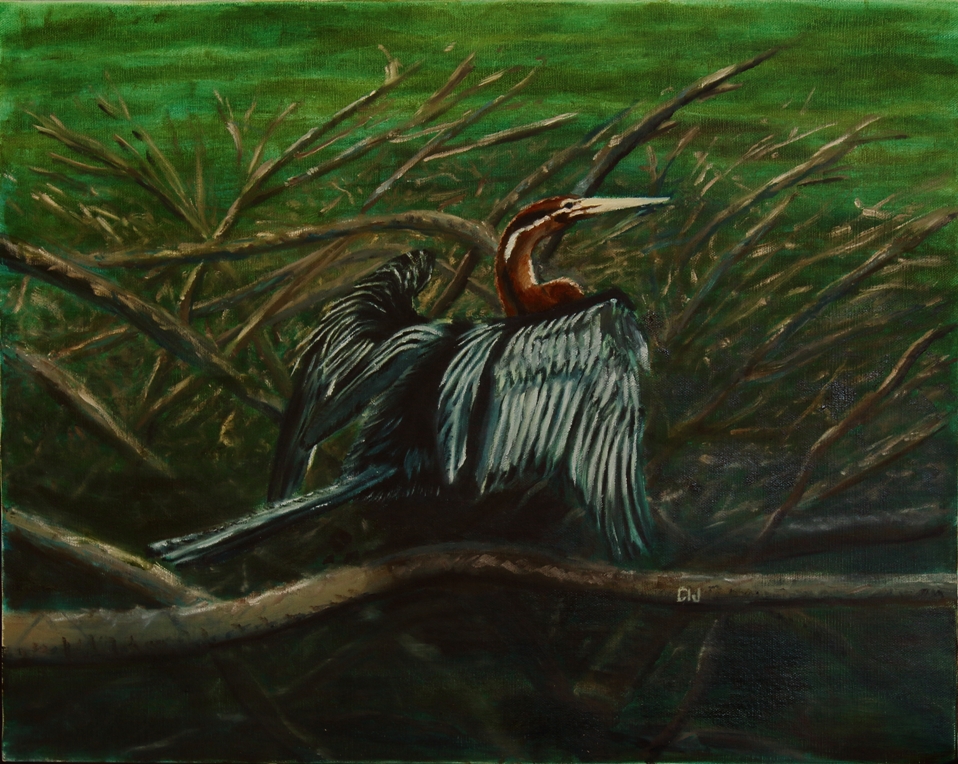
Oil painting of an Anhinga ‘Darter’ (Anhinga rufa)

Living in Africa provides opportunities to approach wildlife with relative ease. Several years ago whilst paddling a canoe down a river in the South of the Continent we came upon an Anhinga drying its wings. It was on a branch at water level and we approached to about four feet without any apparent alarm to the bird. The close quarters photographs were used to create this painting.


Anhinga drying its wings - Oil on canvas board

The painting took several months starting with drawings, a paper model, and then a rough painting prior to the final work presented here. The painting is on W&N 20 X 16 inch artists canvas board. The paint is W&N Artisan water mixable oils.